The message in brief
Before talking about the Holy Spirit's power, Josh traces where the Spirit comes from. He follows a thread of water through the whole Bible: the river flowing out of Eden, the basin at the tabernacle, the river Ezekiel saw pouring from the temple and turning salt water fresh, and Jesus at the Feast of Tabernacles crying out, "If anyone thirsts, let him come to me and drink." Jesus is the true temple, and when his side was pierced on the cross, blood and water flowed.
“He's the spirit of life, and when we are immersed in him, our chaos becomes order and the things in us that are dead come alive.”
Josh BrakeThree things to hold onto
God has always wanted to live with his people
From the garden of Eden to the tabernacle to the temple, the story of the Bible is God making a way to dwell among the people he loves. Sin kept getting in the way, and God kept finding a way back.
“The God who's everywhere wants to literally dwell in time and space, to make himself knowable, seeable, feelable.”
Everything lives where the river goes
In Ezekiel 47 a river flows from the temple, gets deeper and deeper, and turns dead water fresh. Trees grow on its banks, fruit every month, leaves for healing. Water in Scripture is almost always a picture of the Holy Spirit.
“There's healing in this river. It has a healing effect on a broken world.”
The cross is the fountain
When the soldier pierced Jesus' side, blood and water came out. Blood to wash away sin, and water, the Spirit, to fill us. Forgiveness and the Holy Spirit come from the same place.
“The cross of Jesus is the fountain from which the Holy Spirit comes.”
Try this week
Read Ezekiel 47:1-12 slowly, then John 7:37-39. Notice where the water goes and what happens there.
Then ask yourself: what in my life feels dry, salty or dead right now? Bring that place to Jesus by name, ask his river to reach it, and wait on him for a few quiet minutes.
“If anyone thirsts, let him come to me and drink. Whoever believes in me, as the Scripture has said, 'Out of his heart will flow rivers of living water.'”
John 7:37-38 (ESV)Read the transcript
Transcribed from the service recording and lightly cleaned up, so expect a few misheard words. Tap a time to play the message from that spot.
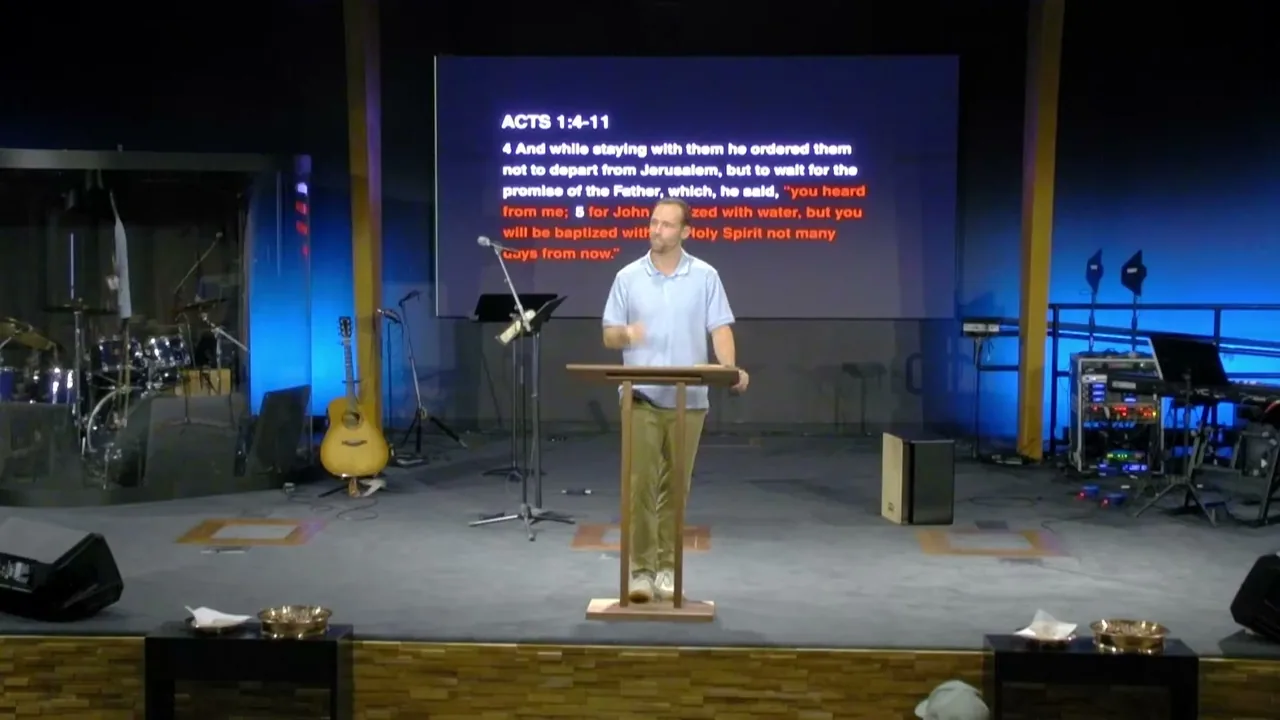
We thank you, Jesus. In your name we pray. Amen. If you have your Bibles, go to Acts chapter 1. Acts chapter 1. Thanks, guys. Acts chapter 1. Acts chapter 1. Last week, we started a journey through the book of Acts. And just to give you the highlights from last week, what I preached on was the desire of God not to just start a new gathering place called the church, but a movement called the church. That the church was birthed by the coming of the Holy Spirit in Acts chapter 2. And what was birthed there was a movement that we're sitting in this room because that movement caught and took hold and expanded to the ends of the earth. And I want to talk tonight about the power that actually made that possible. The person of the Holy Spirit. Let me read the first four verses. I guess five verses. Yeah, my bad. First five verses of Acts. And then I want to talk about it. But I want to frame it maybe a little differently. So I'll explain that in a second. So Acts 1 to 5. In the first book, O Theophilus, I have dealt with all that Jesus began to do and teach until the day when he was taken up after he had given commands through the Holy Spirit to the apostles whom he had chosen.
He presented himself alive to them after his suffering by many proofs, appearing to them during 40 days and speaking about the kingdom of God. And while staying with them, he ordered them not to depart from Jerusalem, but to wait for the promise of the Father, which he said, you heard from me for John baptized with water, but you will be baptized with the Holy Spirit not many days from now. Okay. One of the things I mentioned last week, the shift that the book of Acts makes in contrast to Luke. In Luke, the kingdom of God is the predominant message of Jesus. That's what he's preaching in the book of Luke. It's mentioned like 50, 60 times in the book of Luke, but in the book of Acts, the kingdom of God is mentioned only really eight times. And it, I'm sorry, the Holy Spirit. I'm giving you new stats. The old stat is the Holy Spirit was mentioned like eight or so times in Luke, and then it skyrockets to about like 50, 60 times in the book of Acts. The meaning of that, I think, what we can read into that is it's not really the acts of the apostles, it's the acts of the Holy Spirit. That when the Holy Spirit comes and the life of God begins to course through the people of God, this is what happens. The kinds of things that happen when the Holy Spirit comes and indwells his people. One of the things that I think is happening in this passage, it says, for 40 days, Jesus was hanging out with his disciples, teaching them about the kingdom of God.
So this is one of the very few times, eight times in the book of Acts, that the word, phrase, kingdom of God is mentioned in the book of Acts. Eight times. That's it. And if you were here for our series through Mark, like, kingdom of God was like every chapter it felt like, kingdom of God, kingdom of heaven. And it was the predominant theme in the gospels. When you get to Acts, that theme of the kingdom of God, and even into the letters of Paul, the kingdom of God takes not a back seat, but the emphasis shifts to something different. I think what's happening is that the disciples are realizing that the kingdom of God has come in the person and work of Jesus. It's not just a reality outside of Jesus, the kingdom of God. Jesus is the kingdom of God. He is the rule of God on the earth. He is the dominion of God spreading throughout the ends of the earth. So when you go to the book of Acts and you look at the phrase, word of God, it really means the word about Jesus. His life, death, resurrection, and ascension to the right hand of the Father. That is what they taught in the book of Acts. If you're curious, what did the apostles talk about? They talked about the life, death, resurrection of Jesus Christ. A few times it talks about and they preached the kingdom of God, but it was always close to they preached the kingdom of God and the name of the Lord Jesus Christ. In fact, Philip says that in Acts chapter 8. So now there's this shift and I think what's happening in this moment for 40 days when Jesus is unpacking for them the kingdom of God, he's giving them a new lens through which to see dominion and rule and reign and authority and that lens is of Jesus' work on the cross.
Nobody saw it coming, nobody expected him to die and then rise, be raised from the dead three days later. So now all of a sudden they're seeing him and they probably have questions like, wait, so you died, rose again and you're telling us, so what's this kingdom that you've been talking about? We've seen you heal the sick, we've seen you cast out demons, but what are you really doing here? And I believe for 40 days Jesus is unpacking and showing them how the kingdom of God came through his death and his resurrection, ultimately through deliverance from sin and from death. That the enemy Jesus came to exert authority over wasn't just sickness, it was Satan himself. There's a very real enemy Jesus is coming against with his death and his resurrection. Hebrews 2 talks about that he's destroyed or conquered the one who has the power of death. Satan himself, the accuser, the devil, from the serpent, from Genesis chapter 3 who's threaded throughout all of the Old Testament through the whole Bible that enemy, that's who Jesus came to conquer, not Rome, not any earthly enemy but an enemy that is Satan. I think for 40 days Jesus is showing them I came to conquer him, the one who has the power of sin and death, that's who I came to. I came to conquer and I think that there's light bulbs going off like crazy for these disciples. They're beginning to shift from a message about the kingdom of God to the message about the king.
It's not just that God rules, it's that God rules in Jesus, that he's the risen son of God who's come to exercise the authority of God on the earth. So I think the lens that we need to understand as we go, I'm going to walk through some Old Testament passages because I want to frame the baptism of the Holy Spirit I want to connect the baptism of the Holy Spirit with the work of Jesus on the cross, specifically in his destruction of sin and death because before Jesus could pour out his spirit, he had to pay for sin. That's what he did on the cross. He paved the way and I want to show how that's the pattern that God has worked in for eternity past where he comes and he deals with sin and then he pours out his spirit. It's sin and spirit. There's always a repentance from sin that results in a pouring out of the Holy Spirit. That's the entire story of the Old Testament and it should be encouraging to us but he doesn't just stop operating that way when he sends Jesus. And I have so many passages of scripture that I thought of even during worship. I was like even taking notes. I'm like, don't worry, we're not going to be here forever but we might and you're going to be fine. Okay, just kidding. Okay. The cross of Jesus is the fountain from which the Holy Spirit comes and I want to show you, I want to show you that. So I'm just going to give you some facts really quick.
Jesus, what did he call himself in John chapter 2 if you remember, he is destroying the temple. He's flipping tables and they're like, who do you say you are? Who do you think you are, man? And they're getting mad because he's destroying their place of worship. And Jesus then refers to himself as the temple. He's like, I'm the temple and I will destroy this temple and in three days I will raise it up. Now they don't think he's referring to himself. They think he's referring to the physical temple and they think he's crazy because who could destroy that and then build it back up again in three days? But what he's referring to is himself, his body, as the temple. But for us to really like grasp the weight of that, we have to do a little bit of work in the Old Testament to see where that's coming from. So we're going to go on a little tour of the Old Testament, okay? We're going to go on a little tour. I'm going to take you through this thread and we'll see what happens. I need to pray. Can I pray? Holy Spirit, I am so, I don't say this to be humble. I mean, I am so inadequate to do this right now. To truly reveal the revelation of Jesus, who you are, what you've done, your body and your blood. The Holy Spirit, would you come? Would you speak? Would you teach? Would you anoint, Lord? And even just ask the Holy Spirit for where you're sitting, just ask him to speak clearly for your heart to be open.
We're about to talk about some amazing stuff, but if the Holy Spirit doesn't light it up, it won't be real for us. And I'm not interested in giving a sermon that is not real. That doesn't become an encounter. It doesn't become a portal through which we can encounter the one with holes in his hands and feet. So Lord, I surrender. Thank you for your help. In Jesus' name. Amen. In Genesis chapter 1, God created everything, which is amazing. That there's a God who, because he loves so much, he created the world so that he could love people. What he did is he, the Spirit of God was hovering over the blank canvas of the world. There was chaos, there was darkness, and God brought order and he brought light. In three days, he created order, which is the land, the sky, the sea. He began to fill that order in the second three days with life. And so he's correcting what's wrong with the world. There's chaos and darkness, and he fills it with order and then fills that order with life. What you need to know and understand for context is he's not just creating because he wants to make this really beautiful masterpiece for us to look at and be like, whoa, look at that sunset. That's amazing. Although we do that, what he's doing is building a temple for him to dwell in. He, the God who's everywhere, who's always been everywhere, is building his own temple that he can rest in and fill with himself, his very real presence.
That's his desire. The God who's everywhere wants to like literally dwell in time and space to make himself knowable, seeable, feelable with the senses and with the deepest sense that is our spirit. He wants, that was his goal in the garden. If you know the story, you know that Adam and Eve screwed that up. They royally screwed that up. They sinned and their sin caused a rift between God and man. They were disconnected from the source of life that is God's presence. And one thing, one note I wanted to make, it's a weird detail that maybe you look past, but I want to pull on this thread of water because in Genesis chapter 2, you see in the garden of Eden where mankind started and they were called to steward that space, it says from Eden there issued forth a river and the river split into four parts and it tells you the names of the rivers and all of what's going on there. But what you need to understand is that in the garden, the place where God resides is a river that gives life to everything around it. Now, in the scriptures, the water is almost always a symbol of the Holy Spirit. So when you're thinking about the garden of Eden, one thing you can think about when it comes to the presence of God in Eden is the Holy Spirit is the one, the person of the Trinity that's there breathing life and causing everything to flourish.
So when Adam and Eve sin, they're cut off from the place that water flows. They're cut off from the source of the water and the water itself. And they're called, or not called, they're kicked out into thorny land. He says, the ground is going to work against you now was one of the curses that God pronounced on Adam and Eve. You're going to work the ground and it's going to fight back. So rather than it being filled with the life of the Spirit and them having access to that life, things got a lot more complicated. If you fast forward, there's actually a solution that God had, a solution that God had for his people. I'm fast forwarding like hundreds of years to the point where God says, I'm going to build a dwelling place in the midst of my people. He uses this guy named Moses and he delivers them from Egypt when they're enslaved. Again, I'm skipping a ton of history. I think a lot of us maybe know this already. But one of the things he does is he gives Moses this covenant where it's like, I'm marrying you. It's like a marriage covenant. He comes back into relationship with his people officially and covenantally. And the fruit of that covenant is the presence of God in the midst of his people. But God can't just come and dwell because there's sin. So he has to figure out a way to deal with this sin so that he can come and dwell in the midst of his people.
His solution was to create a physical building called the tabernacle. And the tabernacle had all these blueprints. It was holy, it was expensive, and it was covered in ram skin. And it was this physical location that God would literally come and like become knowable and seeable again. And one of the things that was right outside of that tabernacle was a basin full of water. And this was where the priests would go and they would dip their hands and they would wash themselves before they would do sacrifices. There's the presence of water right there at the tabernacle. So God dwells in this tabernacle with his people for a long time. And this is how they kind of did life. The presence of God was on that tabernacle. It was seeable, knowable, observable. You could literally see the presence of God in a smoke like cloud over the tabernacle. And when that cloud lifted and went, they would follow the cloud wherever it went. And this is how God led them. His presence is what marked them. It's what led them. It was their source of everything. The manna in the wilderness, the quail, deliverance from enemies. If they had the presence of the Lord in their midst, they were the people of God, they were on the mission of God, and they were completely preserved and protected from the enemies around them. One of the things that was true about this tabernacle is there was a sacrificial system to maintain the purity of the place. Because they're people just like you and I. You messed up this week? I've messed up this week. If you and I were Jews in this time, we would have to bring an animal to the tabernacle and literally sacrifice it so that it would take on itself my sin.
So it could continue with the purity of the place. And that God's presence wouldn't run away, not out of fear, but because he's so holy that if he's around anything not holy or pure, he burns it up in an instant. So there's this sacrificial system of goats, oxen, cows. It was all of these different animals you could bring depending on how much money you own as a family. And you brought it and you sacrificed it as atonement for your sins so you could continue to be a part of the people of God and live within the presence of the Lord. Okay. Fast forward. New King. I'm going fast. This is a lot of history. But fast forward. There's this king. His name is David. And David's the best king. He's the guy that is the Lion of Judah, right? He's the guy who was the greatest king of Israel. He killed lions and bears with his bare hands and killed Goliath with the sling. It's that guy. And he's also a poet. And he's also the guy who wrote most of the Psalms, if not all the Psalms. And this guy is who God saw and said, I want to make you king because he saw something in David's heart that he wanted on the throne. He didn't see a warrior. He saw a lover. He saw a pure heart. Somebody who loved God more than platform. Who loved God more than how much God used him. Just a guy who just loved God, pure heart, would be more content in a field by himself with his sheep singing to the Lord than sitting on a throne making pronouncements in the kingdom. This is who King David was. And that king had it in his heart to not just build a tabernacle, but a house that far exceeded anything the tabernacle did.
Same pattern, same pattern, but different. And it was different through worship and songs and praise. And I don't want to, I don't, I have time to get into all of this right now. I just need you to know that from the tabernacle came this guy David who wanted to build this house who was ultimately fulfilled by Solomon, his son. So his son, the second king, after David, he decides to use all of his wealth to build this amazing house for God. And he combines David's tabernacle of worship and praise with the sacrificial system from the tabernacle and puts them together and has this amazing house full of worship and sacrifice and sin being atoned for. And it was this place that God resided in the innermost part of this temple. And that presence was observable, tangible, felt, knowable, not just, I know God's with me, I can see that God is with me, that God is among us. And every tribe was actually situated around it so that they were facing inward towards the tabernacle or towards the temple. And when they faced the temple, they were immediately aware, they walk out of their tent in the morning and the first thing they see is the cloud on that temple. And they would remember that I'm a person of God's presence. That what makes me, is that God is with me. Nothing else. Their identity was purely, I'm a person of God's presence.
And this is God trying to restore what was lost in Eden. The presence of the Lord among his people. He's finding a way out of love and grace. He desires to still be around his people even though they've rejected him and run from him. And he's finding a way, saying, building a house so that he can dwell in the midst of his people whom he loves again. But there's a story in Ezekiel. Yeah, Ezekiel. Ezekiel chapter 10. This prophet comes and he's speaking to these people because they have sinned again. Israelites. They have continued to sin, continued to run from God, continued to worship idols, and they're not regarding God as the one true God. They're taking advantage of the presence of the Lord and they're worshiping other idols. And finally, God has enough and he says, you know what? Fine. Here's the consequence. Same thing that happened with Adam and Eve in the garden. When I left them, my presence left them and they left my presence. I'm leaving the presence of my people. In Ezekiel chapter 10, you see a picture of God's presence physically leaving the temple and going far away. But at the end of Ezekiel, in Ezekiel 47, I think I have that one now. I know I'm moving quickly. But this thread is throughout the whole scripture and gives context to the baptism of the Holy Spirit. But in Ezekiel 47, I'll just read it from the screen. I'm going to go in verse 1 and then I'm going to go to verse, I think, 7 or something. But what you need to know context-wise is at this point in Ezekiel in chapter 47, God's already made a plan and has rebuilt a temple. His presence has left the temple and there's all these chapters in between right now.
And what's happened in that chapter is Ezekiel sees a new temple and God is restoring what was lost. And one of the final things that they see, once the temple is finished, it's built and everything is ready to go, what happens is this, then he brought me back to the door of the temple and behold, water was issuing from below the threshold of the temple toward the east for the temple faced east. Where did the water issue forth from in Eden? It was towards the east. You're seeing this water theme again. The water was flowing down from below the south end of the threshold of the temple south of the altar. Now let's skip. What does that water do? Go to verse 7. As I went back, I saw on the bank of the river very many trees on the one side and on the other. And he said to me, this water flows toward the eastern region and goes down into the Arabah and enters the sea. When the water flows into the sea, the water will become fresh. Well, fresh water is drinkable. Fresh water gives life. Salt water doesn't. What's happening is undrinkable water that doesn't give life is becoming drinkable and able to give life. How? Because of the water that's issuing from the presence of the Lord in the temple. From the very heart of the temple, water flows and it makes undrinkable water drinkable. But what else does it do? Let's keep going. And wherever the river goes, every living creature that swarms will live and there will be very many fish. For this water goes there, for this water goes there, that the waters of the sea may become fresh, so everything will live where the river goes.
Everything will live where the river goes. Fishermen will stand beside the sea. From En-Gedi to En-eglaim. Wow. It will be a place for the spreading of nets. Its fish will be of very many kinds, like the fish of the great sea. But its swamps and marshes will not become fresh. They are to be left for salt. And on the banks on both sides of the river, there will grow all kinds of trees for food. Their leaves will not wither, nor their fruit fail, but they will bear fresh fruit every month because the water for them flows from the sanctuary. Where does it flow from? The sanctuary. This isn't a random pool of water. This is a water that has a very specific source. It's from the sanctuary, the temple of God where he dwells. Their fruit will be for food and their leaves for healing. It's amazing. This is the vision Ezekiel's having of the temple. Water's coming from the temple, going east, getting deeper and deeper, and everywhere the river goes, there is life. Trees are springing up and fish are multiplying. And those trees have leaves that are used for healing. There's healing in this river. It has a healing effect on a broken world. Where is it coming from? The sanctuary. The temple where the presence of the Lord resides. This is the vision of the new temple.
And now, this will be ultimately fulfilled physically in the coming kingdom later. But what did I say at the very beginning? Jesus is the temple. So, let's connect this because this is a vision of what's to come. But what's true about Ezekiel is he's still prophesying and the Israelites are still far from God. And they finally get sent back. They were in exile for a long time. They get sent back and they try to rebuild the temple. It's nothing compared to what it used to be. And then there's silence for hundreds of years until someone breaks the silence named John the Baptist. He breaks the silence. There's 400 years of silence and this man, this crazy man wearing camel hair and eating locusts for dinner is in the wilderness begins speaking this message about the kingdom of God being at hand and repent. And what does he do? His ministry was marked by a baptism in what? Water. He's reminding them of the life that they were created for. But it's the fruit of repentance. It's turning from sin going to this man John who would then immerse him or them or her in water and they would come out and bear fruit in keeping with repentance. They didn't just stand on the banks and look at the water. They were immersed in the water and that is the comparison that John makes with what Jesus was going to do later which is I baptize you with water but there's one who's coming who will baptize you with the Holy Spirit. The baptism of the Holy Spirit is a fulfillment of God's promise to dwell in the midst of his people and to bring life wherever he goes.
He's the spirit of life and when we are immersed in him our chaos becomes order and the things in us that are dead come alive. The baptism of the Holy Spirit isn't just about power. It is specifically in Acts. I don't want to be unfaithful to what Acts 1 says. It is about power. They do receive power but what's that power unto? Extending the rule and reign of Jesus on the earth and sometimes you need power to flip things on its head. Actually every time you need power to flip things on its head. Sometimes when chaos becomes order it's so foreign to that person that it requires a flipping. It requires something dramatic something traumatic to happen to their physical body and their soul. When the Holy Spirit who is God comes on someone to bring order to the chaos and life to dead things in them they will feel it. And I'm going to talk about power next week but what I wanted to focus on this week was the presence of the Holy Spirit because the presence of the Holy Spirit comes from God himself. He is God himself and he issues forth from the true temple that is Jesus. There's this amazing story in John chapter 7.
John chapter 7. There's a feast that's called the Feast of Booths or Feast of Tabernacles and during this feast it's actually happening right now and guess what I did not know that when I prepped this message. You know that? It's crazy. The Feast of Tabernacles started yesterday and is going until Friday October 2nd. Friday October 2nd. I feel like there's something prophetic there. Maybe we're in for it tonight. The Feast of Tabernacles is a feast celebrating God delivering his people from Egypt and they would leave the comfort of their homes to literally dwell in tents because that's all they had in the wilderness after they were delivered from Egypt. So they would leave the comfort of their homes and they would dwell in a tent. This is a reminder of God's deliverance leaving the comfort of sin and slavery for true comfort which is the presence of the Lord even if it might be in the wilderness. And that's the feast that's happening when Jesus says what he says in John 7:37. Now what you need to know also is that there was a tradition on the last day of the feast where there would be a procession that would go from the temple led by the high priest they would walk down to the pool of Siloam and they would fill a golden jar with water and they would come back and they would walk over to the top of the steps by the center of the temple or the entrance of the temple and they would take that water and they would take wine and they would pour both of them into one vessel and then pour it over the steps symbolizing Ezekiel 47 that the water is issuing forth from the center of the temple down the steps and it's that day on the last day of the feast when they're doing that procession that Jesus says what he says in John 7:37 7:37. On the last day of the feast the great day Jesus stood up and cried out if anyone thirsts let him come to me and drink whoever believes in me as the scripture has said out of his heart will flow rivers of living water now this he said about the spirit whom those who believed in him were to receive for as yet the spirit had not been given because Jesus was not yet glorified I used to always think that when Jesus said out of his heart will flow rivers of living water that he was talking about me and you I don't think that's what this is talking about because this can also be read this way Jesus stood up and cried out if anyone thirsts let him come to me and let him who believes in me drink as the scripture has said out of his heart will flow rivers of living water with that reading who's it talking about Jesus he's the one that from his heart flows rivers of living water and what did I already say Jesus is the temple Jesus is the temple and from his heart the true temple flows rivers of living water and he's saying if you want that you come to me and you just believe in who I am and from his heart will come rivers of living water that we get to drink from and the saltiness in us becomes fresh and the dead things in us become alive but notice what it says at the end it says now this he had said about the spirit whom those who believed in him were to receive for as yet the spirit had not yet been given because Jesus was not yet glorified in the book of John means lifted up upon the cross means lifted up on the cross so let's make another connection this temple is going to be lifted up upon the cross from his heart is going to flow rivers of living water and so in John 19 can we see the fulfillment of that John 19 this is the fulfillment of what is promised in John 7 in verse 31 I didn't have 31 but I'll back up to 31 then I'll get to 34 and 35 since it was the day of preparation so that the bodies would not remain on the cross on the Sabbath for that Sabbath was a high day the Jews asked pilot that their legs might be broken and that they might be taken away so the soldiers came and broke the legs of the but when they came to Jesus and saw that he was already dead they did not break his legs but one of the soldiers pierced his side with the spear and at once there came out blood and water he who saw it has borne witness his testimony is true and he knows that he is telling the truth that you also may believe for these things took place that the scripture might be fulfilled not one of his bones will be broken and again another scripture says they will look on him whom they have pierced here you have Jesus hanging on a cross already dead and when his heart is pierced what comes out water and blood water and blood and John even says like I promise the testimony is true because he understands the weight of the reality of the blood and water coming from the side of Jesus the true temple hung upon a cross gave up his life and from his heart came living water and blood why blood to cleanse from sin and to pave away for the life of the Holy Spirit the very presence of God to come so when in Acts chapter 1 he's telling them to wait in Jerusalem until the coming of the promise of the Father the promise of the Father is everything I just mentioned to you Ezekiel 47 I can go to Isaiah 44 maybe I'll read that here in a second all of these are promises from God that I'm going to dwell in the midst of my people I must first deal with sin and then I'll send my spirit and on the cross Jesus does both he's the source of forgiveness of sins and faith and from him will flow rivers of living water and in Acts chapter 3 Peter's talking about this and he's talking like Jesus sent down the Holy Spirit and this is what you're seeing and then he does this amazing miracle in Acts chapter 3 and he says this that when you I didn't say this in verse 19 but in verse 19 he repentance from sin is connected to the sending of the Holy Spirit and both of those happen in one place that's the cross of Jesus Christ who's the fulfillment of the promise that God desires to dwell in the midst of his people and when you see in Acts chapter 2 which we'll really dive into next week maybe the next what happens when the Holy Spirit comes the coming of the Holy Pentecost is celebrating the giving of the law when God gave the law to Israel in Exodus chapter 19 they broke it immediately and what resulted was 3,000 people were killed death right in the feast of Pentecost the coming of the Holy Spirit in gave life to 3,000 people it's the reversal the ministry of the law brought death but the ministry of the Spirit brings life he's the water of God the river of Jesus that he longs to quench our thirst he longs to fill dry places with his life he longs to bring healing where there's brokenness he longs to give you everything Jesus has given or purchased for you on the week I was first baptized with the Holy Spirit, I would have described it as more of a dousing in his presence than a feeling of his power.
There was power because from then I started to do things that I couldn't do. But before, I wouldn't have described it as like, some people describe that as like I felt the power come upon me and I went and I just saw all these signs and wonders. That wasn't what happened to me. I pray that happens to me. I always want more. What happened to me was I remember being in a room with worship on and that water of the Spirit came and refreshed my heart and love filled my body, my being. And it was like I was home for the first time in my life. I believe I was a Christian before that, but I was doused in the presence of the Holy Spirit in that moment. I was immersed, baptized in the presence of another person that night. And that continued for two months. I just remember just that river was flowing from Jesus's heart into my spirit, into my body, into my mind. The fruit of it was healing. The fruit of it was all these things I knew about God began to connect in my heart. Dry places were quenched. Intimacy with God became something that I pursued intentionally. Everything came to life. Things sprung up in me that I didn't know were there. All because God came. And so we're gonna we're gonna take communion. We're gonna recite the Nicene Creed.
And specifically, there's a part of the Nicene Creed that leans in on the Holy Spirit. And it's a really powerful little statement about him. Let's focus on these words. I believe they'll form us. And then we're gonna receive the Lord's body and blood and then wait for the Holy Spirit to baptize us. Some of us need refreshing. We need a touch. We need the river of God to flow into our hearts and minds and bodies again. I need it. I need it every day. And we're just gonna wait on him for a few minutes and just let him come and do that. And so, Terry, can you put up the Nicene Creed? And for this, I'm gonna, I didn't have to turn my mic